Tuesday, January 10, 2012

Child sacrificed, liver offered to gods

Child sacrificed, liver offered to gods

[Bismillahnews.in-05-01-12-RAIPUR-Kuwait Times] A seven-year-old Indian girl was murdered in a tribal sacrifice and her liver offered to the gods to improve crop growth, police in the central state of Chhattisgarh said yesterday. The body of Lalita Tati was found in October one week after her family reported her missing.
"A seven-year-old girl was sacrificed by two persons superstitiously believing that the act would give a better harvest," Narayan Das, the police chief of Bijapur district, told AFP by telephone.
The two men was arrested on Wednesday on suspicion of killing the girl and offering her liver to the gods in a grisly tribal ceremony. Police said the men had confessed to the crime. The girl was murdered in a jungle district of Chhattisgarh that is a stronghold of rebel Maoists who have tapped into disaffection among local tribal groups.
Human sacrifices occasionally make headlines in deeply religious and superstitious India, and usually occur in poor areas where some people revere practitioners of black magic.
Two suspected child sacrifices were reported in Chhattisgarh in 2010, while in the same year the decapitated body of a factory worker was found in a temple in the eastern state of West Bengal. The victims are often ritually killed by witchdoctors to appease gods, spirits or deities. —AFP

http://new.kuwaittimes.net/2012/01/01/child-sacrificed-liver-offered-to-gods/


--
Shahzad Afzal
http://www.pakistanprobe.com/


Read More >>

Huge Profits For Congressmen Voting For " WAR "


Last week we uncovered how many billions of dollars the wars in Iraq, Afghanistan, and Pakistan are costing the American taxpayers. We all know that war costs a lot of money. What we don't know is that the same people who profit off the wars we create have a direct influence in shaping the foreign policy that keeps America at war while putting millions of dollars in their own pockets.

Here is the way our government system is supposed to work: foreign policy is supposed to be drafted between the President and Congress, and the Secretary of State. In the present administration, this is Hillary Clinton. She is supposed to serve as the President's main foreign policy advisor. What is foreign policy? Foreign policy is a set of goals outlining how a country will interact with other countries economically, politically, socially and militarily. These days, many of our elected representatives have become merely the messengers of foreign policy prescriptions that were created by councils and think tanks comprised of CEOs and executives from the biggest corporations in the world. On these councils sit executives from every major industry from food to media and, most shockingly, national defense.

Is if there is a conflict of interest when CEOs of the largest defense corporations are advising our lawmakers on foreign policy? Before you decide ask yourself this: if you were the CEO of Lockheed Martin, the largest defense corporation in America, and 95% of your company's $35 billion dollar annual profit came directly from government contracts that employ you to supply war materials, would you want the war to end? Especially if you personally enjoyed a $21 million increase in compensation from 2005 to 2008 as a result of the War on Terror? Between 2001 and 2005, defense corporations' annual profits climbed 189%, and the CEOs of these corporations that benefited the most from this profit increase sit on councils together with our politicians to "recommend," "suggest" and "prescribe" foreign policy.

In this episode of YOURTRUTH, we are going to take a look at how much influence the CEOs of the top defense corporations have on the shaping of our foreign policy, specifically the foreign policy that has kept us at war. Let's start with Robert Stevens, who we mentioned earlier is the CEO and President of Lockheed Martin, the number one defense corporation in the nation. Stevens is the presiding director of Monsanto, the largest manufacturer and distributor of genetically modified seeds, a member of the Council on Foreign Relations, and a member of the Advisory Board to the Atlantic Council. So what are these councils?

The Council on Foreign Relations is a powerful think tank comprised of the worlds' biggest CEOs and executives in banking, oil, media, mining, food, real estate investment, and politics. A few of the most recognizable political members include David Rockefeller, John McCain, Dick Cheney, Colin Powell, and Madeleine Albright. President of the CFR, Richard Hass, was the former Director of policy planning for the Department of State. CFR board member Richard Holbrooke is Obama's Special Advisor on Afghanistan and Pakistan. According to their website, one of their functions is to sponsor "independent task forces that produce policy prescriptions on the most important foreign policy topics." Let's not forget that corporate CEOs don't take an oath to serve the best interest of the American people: their primary obligation is to maximize company profits.

I know, we all want to believe that our politicians are incorruptible and won't take corporate dollars that might sway their decision making. But would millions of dollars sway you? According to recent reports from OpenSecrets.org, 151 members of Congress in 2006 had up to $195.5 million of their personal assets invested in defense corporations. What does this mean? When members of our Congress vote to keep us in war, are they really doing it for the safety of the American people, or are they doing it because their stocks will increase, giving them a bigger payout?

Major defense corporations were seriously involved in the 2008 elections as well. Lockheed Martin gave $2,612,219 in total political campaign donations, with 49% to Democrats ($1,285,493) and 51% to Republicans ($1,325,159). Boeing gave $2,225,947 in 2008 with 58% going to Democrats and General Dynamics provided $1,682,595 to both parties. Northrop Grumman spent over $20 million in 2008, hiring lobbyists to influence Congress, and Raytheon spent $6 million on lobbyists in the same period. Wow. That is a lot of money… I wonder what these corporations expect in return for their campaign handouts?

Well, all we have to do is look at the policy prescriptions they help draft and provide to our politicians. For example, let's take a look at the Atlantic Council's most recent proposal, outlining U.S. policy objectives with Pakistan. Senator John Kerry, who personally has over $30 million invested in defense companies, and Atlantic Council chairman Chuck Hagel just recently proposed the plan to the Senate Foreign Relations Committee for review.

So what is the Atlantic Council? Well according to their website, they focus on "drafting roadmaps for U.S. policy towards the Balkans, Cuba, Iraq, Iran and Libya." Other than Robert Stevens, CEO of Lockheed Martin, who else belongs to this council? Corporate membership includes all four of the top four defense corporations in the country: Lockheed Martin, Boeing, Northrop Grumman, and Raytheon. Another interesting fact is that General Jim Jones left as chairman of the Atlantic Council to work as Obama's National Security Advisor, and four other prominent officials from Obama's administration are also members: Susan Rice, Richard Holbrooke, General Eric Shinseki, and Anne-Marie Slaughter.

In both the Council on Foreign Relations and the Atlantic Council we see corporate CEOs and politicians working together to draft and implement foreign policy that will financially benefit those invested in the defense industry. Whose interest does this serve: the American people who are paying their hard earned tax dollars for these wars, the CEOs of defense corporations who are profiting from these wars, or the politicians who are personally invested in continuing these wars? Need more proof of the revolving door relationship between corporations and government? According to Project Censored, President Obama recently nominated Raytheon's Senior VP for government operations and strategy, William Lynn, for the number two position at the Pentagon.

One of the other top defense corporations is Boeing. Current CEO of Boeing, James McNerney, Jr. is a sitting member of the Business Roundtable. What is the Business Roundtable? CEOs of the top 160 corporations present government officials with "reasoned alternatives and positive policy suggestions." Also, it is not unusual for Business Roundtable members to meet with the President and his staff in private.

Northrop Grumman, the 4th largest defense corporation in the world, saw net sales of $7.6 billion in 2000 skyrocket to nearly $34 billion by 2008. According to Corpwatch, at least seven former officials, consultants or shareholders of Northrop Grumman held positions in the George W. Bush administration. It is also noteworthy that, in the last ten years, Northrop Grumman shelled out $8.5 million in campaign contributions to both parties.

To spell it out, defense corporations are making millions by the wars we create. Our politicians are also financially benefiting from the wars we create. The cozy relationship that many in our government have with the most powerful leaders in the defense industry should be a significant cause for concern for any taxpaying American. If our foreign policy decisions are intertwined with the business interests of major corporations, the voices and opinions of American voters will be sidelined and ignored. The time is now to stop the corruption and end this war. Tune in next week to find out what people are doing all over the world to end this war and restore peace. It is time for a change, and this change starts with you.

Media Roots


--
Shahzad Afzal
http://www.pakistanprobe.com/


Read More >>

Monday, January 9, 2012

Pakistan's President Zardari fights back at moves to oust him


BY TOM HUSSAIN

MCCLATCHY NEWSPAPERS

ISLAMABAD, Pakistan — The Pakistani government has mounted a counterattack against moves by the country's military and Supreme Court that could result in what critics call a constitutional coup against President Asif Ali Zardari.

The Supreme Court had set a Jan. 10 deadline for the government to request that a Swiss court reopen a corruption case against Zardari, but his ruling Pakistan People's Party said Thursday that the government would ignore it. At a meeting held at the presidential offices — in defiance of a court order against such use of the premises — the party said it would uphold the president's constitutional immunity from prosecution.

The party also said that Zardari wouldn't respond to a summons from a judicial inquiry ordered by the Supreme Court to investigate allegations that a top Zardari aide had sought White House help to dissuade the Pakistani military from staging a fifth coup in 64 years.

The moves figured to prolong a standoff that has brought Pakistani politics to a standstill and threatens to imperil U.S. efforts to enlist Islamabad's help in achieving peace in neighboring Afghanistan. With military officials seemingly bent on removing Zardari — whom they view as a threat to their considerable power — and the president digging in his heels, the turmoil also has distracted attention from the country's worsening economic difficulties and a decisive phase of its war against Pakistani Taliban insurgents.

Four major Pakistani Taliban factions had on Sunday pledged to end attacks on Pakistani security forces and join the war against U.S.-led NATO forces in Afghanistan. However, the pledge rang hollow on Thursday after one faction, led by Hakimullah Mahsud, announced it had executed 15 paramilitary soldiers kidnapped from a fort in December.

The Supreme Court panel's inquiry focuses on a memo that Pakistan's former ambassador to Washington, Hussain Haqqani, is alleged to have drafted for Gen. James Jones, who was then President Barack Obama's national security advisor. The claim was made in October by an American businessman of Pakistan origin, Mansoor Ijaz, who said he delivered the memo.

Jones has acknowledged receiving the memo and forwarding it to the then-chairman of the Joint Chiefs of Staff, Adm. Mike Mullen. Both have said they doubted Ijaz's claims and hadn't considered the memo to be authentic.

The Pakistani government has rejected Ijaz's claims. It was furious when the army chief and the head of the military spy agency, the Inter-Services Intelligence directorate, told the Supreme Court in December that they believed Ijaz's claims warranted a judicial investigation.

The ensuing rhetorical back-and-forth in court and in the Pakistani media have sparked rumors of a coup against Zardari.

His government appeared to win a boost Wednesday when opposition leader Nawaz Sharif — who had filed the petition asking the Supreme Court to look into Ijaz's claims — said that he'd welcome negotiations with the government on efforts to rein in the military. Sharif has feuded with the military since it overthrew him as prime minister in 1999, forcing him into a 10-year exile in Saudi Arabia.

"I don't think the government is really serious about restricting the political role of the army and intelligence services, but if it is, I'm ready for talks," he told Geo, the leading Pakistani cable news channel.

As clips of Sharif's interview were broadcast, the federal cabinet ordered all military officers, civil servants and judges to declare their financial assets — a first in Pakistan's history.

It also wasn't clear whether Research in Motion, the Canadian maker of the BlackBerry, would comply with a request by the judicial inquiry for transcripts of text-message conversations between Ijaz and Haqqani. Ijaz said that those conversations contained evidence that supported his claims, but the firm said in a statement Wednesday that it would "balance any such requests against our priority of maintaining the privacy rights of our users."

The Supreme Court's decision to form a judicial commission to investigate the so-called Memogate charges against Haqqani and Zardari has drawn fire from human-rights groups. They have zeroed in on the court ruling that national-security interests trumped the constitutional rights of Haqqani, who hasn't been charged with any criminal offense but was ordered by the court not to leave Pakistan.

Pakistan's chief justice, Iftikhar Chaudhry, has frequently clashed with Zardari since the government reinstated Chaudhry in 2009. Chaudhry has since frequently initiated corruption and other proceedings against the government and overruled it on administrative matters, drawing criticism from international jurists.

The Supreme Court has been notably less vigorous in its pursuit of allegations of human-rights violations by the military.

Meanwhile, Haqqani is holed up at the prime minister's official residence in Islamabad. In an interview with the Daily Telegraph, published Wednesday, he said he rarely left the compound out of fear of being kidnapped and tortured, or even killed. Although he didn't identify the source of the threat, he alluded to the military.

(Hussain is a McClatchy special correspondent.)

--
Shahzad Afzal
http://www.pakistanprobe.com/


Read More >>

Obama's plan: less troops, more fire from the skies


                                   http://youtu.be/bLNYXcdB3vs

DER SPIEGEL

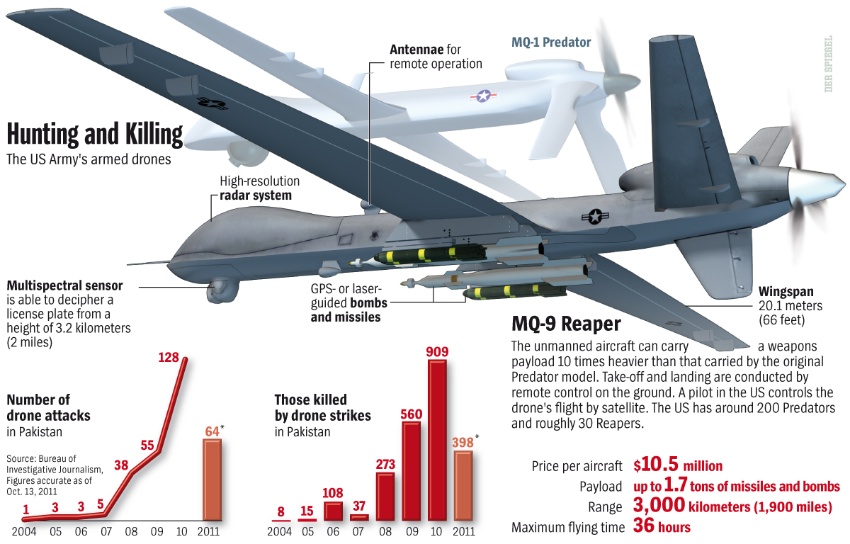
They are difficult to detect, deadly and cheap to build. Despite the dubious legality of assassinating suspected terrorists and Taliban without a trial, the market for drones is heating up around the world. With Israel and China moving into the market, are we about to see a new arms race?

The US is carrying out drone strikes ever more frequently. Vice President Joe Biden, especially, has been an effective advocate for the weapons. It was Biden who urged his boss to end the war in Afghanistan and instead to combat the Taliban with drone strikes on their hideouts in Pakistan. Nobel Peace Prize winner Barack Obama now sends out a missile-equipped drone an average of once every four days, while his predecessor, George W. Bush, did so only once every 47 days. Obama, it seems, has taken a liking to remote-controlled war, which delivers faster results and is less complicated than wrangling with Guantanamo.

The American fleet now stands at 230 drones. The Air Force trains more pilots for drone operations than for fighter jets, and last month acknowledged the existence of previously classified drone bases in Ethiopia, the Seychelles and Djibouti.

American manufacturers such as Northrop Grumman and General Atomics would like to start marketing their products to the rest of the world, and their representatives serve as cheerleaders urging more and more new drones. "Countries have an insatiable appetite for drones," James Pitts, from defense contracting giant Northrop, told the Financial Times. Northrop representatives recently visited Japan, bringing along a 1:1 model of the enormous "Global Hawk" drone. The same drone, under the name " Euro Hawk" will soon be stationed with the Bundeswehr, Germany's Armed Forces, at its air base in Jagel in northern Germany.

A United Nations report lists over 40 countries that have bought remote-controlled aircraft, although most of these are used for aerial reconnaissance, the original purpose for which drones were designed. So far the only countries to carry out drone strikes, besides the US, are Israel and Great Britain.


--
Shahzad Afzal
http://www.pakistanprobe.com/


Read More >>

Friday, December 23, 2011

Keep Obama on your call list and on your dua list

Assalamu Alaikum

President Obama has not signed the National Defense Authorization Act yet. That spells opportunity.

The President's intention to sign a bill enshrining indefinite detention into U.S. law is provoking unprecedented rage throughout America. A New York Times editorial says:

President Obama came into office pledging his dedication to the rule of law and to reversing the Bush-era policies. He has fallen far short.

This pressure may be giving the former professor of Constitution Law, President Obama that is, a pause. And maybe your dua against the bill and calling pressure on him to veto will do the job.

If this NDAA 2012 becomes a law it will allow the military to imprison anyone indefinitely without trial or a charge including the US citizens from your neighborhood and green card holders next door, just based on suspicion.

President Obama while receiving his Nobel Peace Prize said:

"We lose ourselves when we compromise the very ideals that we fight to defend. And we honor those ideals by upholding them not when it's easy, but when it is hard."

This country's ideals have always been in rights and freedoms for individuals, in justice and equality. The National Defense Authorization Act with its provisions on indefinite detention does not live up to the ideals of our constitution.

You must remind Obama of his own words that he must stand up for justice even if it is hard.

Call President Obama Now: 202-456-1111.

  • Remind him of his quote above
  • Ask him to veto indefinite detentions in NDAA 2012 bill
  • Call ten friends, colleagues and relatives to call President Obama as well. Do it every day.
  • Forward this action alert with your friends.

Join Our Network!

We work with several partners on this issue, Muslim Peace Coalition USA organized conference calls to develop responses to the NDAA bill. The first call was attended by 20 national and regional Muslim organizations and the second was attended by 32 peace, justice, and interfaith groups.

If you would like to join this network and participate in our conference calls please fill out the following form to let us know about your networks advocating for peace and justice.

Thank you BORDC.

One of our past action alert essentially used the Bill of Rights Defense Committee's action alert without quoting or referring to it. We are thankful to their great work and regret the omission.

Please Donate to Muslim Peace Coalition USA

Muslim Peace Coalition USA
The Muslim Peace Coalition USA is a grassroots alliance that has spread to 14 states since its inception. The Coalition's mission is to work closely with the peace movement and civil rights organizations to oppose war, terrorism and Islamophobia.

Muslim Peace Coalition, USA
202-643-JUST
www.MuslimPeaceCoalition.org

--
Shahzad Afzal
http://www.pakistanprobe.com


Read More >>

Thursday, December 15, 2011

Nato's fraught roads to Afghanistan

By Natalia AntelavaBBC News, Bishkek

Pakistan's decision to shut down Nato supply routes going through its territory means that for the coalition the only remaining overland route to Afghanistan is through Central Asia.

The US military is now preparing to shift more traffic along the roads, rail and air routes that run between the Baltic Sea and Afghanistan via the Caucasus and Central Asia - the so-called Northern Distribution Network.

These routes have been crucial in supplying coalition soldiers in Afghanistan since the war began in 2001.

But in recent months, as Washington's relationship with Pakistan has deteriorated, there has been a steady increase not just of cargo but also diplomatic traffic to secure the support of Central Asian leaders who guard the precious access routes to Afghanistan.

Continue reading the main story

"Start Quote

Manas provides proximity. From here the international effort can be sourced much quicker than from any other location in the world"

Col James JakobsonManas Transit Center

But the way through the post-Soviet Stans - as the Central Asian republics are known - is fraught with difficulty and controversy.

Huge blow

In Kyrgyzstan, the newly elected leader Almazbek Atambayev says he wants to shut down Manas air base just outside the capital Bishkek because he sees it as a threat to Kyrgyz security.

"What if America goes to war with Iran and next thing we know Tehran will be bombing Manas," he said in a BBC interview shortly after his election in October.

Mr Atambayev said his decision not to extend the lease when it runs out in 2014 was non-negotiable, and that the US should respect the agreements it signed.

In the past, the US has played down similar statements from Mr Atambayev's predecessors, saying there were alternatives for a similar base elsewhere.

And, anyway, US President Barack Obama hopes to get combat troops out of Afghanistan by 2014.

But many experts say the closure of the base would be a huge blow for the US, especially at the time it is withdrawing.

Virtually every Nato soldier passes through Central Asia and on any given day there are some 2,000 troops coming through Manas, either on their way to Afghanistan or on their way home. The base is also used for refuelling fighter jets and bombers in Afghanistan.

"It takes only two hours to get from here to Kabul," says Col James Jakobson, who is in charge of the Manas Transit Center.

Map: Northern Distribution Network

"So Manas provides proximity. From here the international effort can be sourced much quicker than from any other location in the world."

With the future of the base uncertain and routes via Pakistan unreliable, the US has also been courting other Central Asian leaders.

In the same week as the White House was congratulating Libyans on the death of Col Muammar Gaddafi, Hillary Clinton stood in front of the cameras in Tashkent shaking hands with a man whose human rights record is often compared to the former Libyan leader.

"I wanted to come to Tashkent, to see you and to see your people," she said, smiling broadly at Uzbekistan President Islam Karimov, who nodded approvingly.

"He is the biggest beneficiary of the troubles between the US and Pakistan and he can't believe his luck," said a Tashkent-based journalist, who did not want to be named for his personal safety.

"This will benefit him enormously - both politically and financially and it's bad news for whatever is left of civil society here."

'Scared of 2014'

Stern, short and stocky, Mr Karimov may not have the flamboyance of the late Libyan leader and, unlike Libya, his country has never been on the radar of the Western media or its public.

But there is, observers say, plenty of room for comparison.

"When it comes to human rights abuses, lack of freedom and a complete intolerance of dissent, Mr Karimov is right up there with some of the most brutal of Arab dictators," says Paul Quinn-Judge, Central Asia Director for the International Crisis Group.

But this autumn the US Congress lifted its ban on military aid to the Uzbek regime, seven years after imposing the measures because of widespread human rights abuses.

Rights groups accuse the US of empowering one of the world's most brutal regimes.

"The Obama administration is clearly scared as 2014 is approaching and they don't only need to get the troops in and out of Afghanistan, they'll need to get a lot of expensive equipment out," says Mr Quinn-Judge.

"But this is foreign policy reduced to problem solving. The problem is Afghanistan, the solution is seen to lie with Islam Karimov."

Mr Obama's priority is to end the war and get the troops home.

But paving routes out of Afghanistan is a challenge, and many fear that the deals Washington makes along the way could have a lasting impact on the whole region.


--
Shahzad Afzal
http://www.pakistanprobe.com/


Read More >>

Wednesday, December 14, 2011

Russia Considers Blocking NATO Supply Routes


NOVEMBER 28, 2011, 2:27

By ALAN CULLISON

MOSCOW—Russia said it may not let NATO use its territory to supply troops in Afghanistan if the alliance doesn't seriously consider its objections to a U.S.-led missile shield for Europe, Russia's ambassador to NATO said Monday.

Russia has stepped up its objections to the antimissile system in Europe, threatening last week to deploy its own ballistic missiles on the border of the European Union to counter the move. The North Atlantic Treaty Organization says the shield is meant to thwart an attack from a rogue state such as Iran, that it poses no threat to Russia, and that the alliance will go ahead with the plan despite Moscow's objections.

If NATO doesn't give a serious response, "we have to address matters in relations in other areas," Russian news services reported Dmitri Rogozin, ambassador to NATO, as saying. He added that Russia's cooperation on Afghanistan may be an area for review, the news services reported.

Threats to the NATO supply line through Russia come at an awkward time for the alliance. NATO has become increasingly reliant on the Russian route as problems in Pakistan—its primary supply route—have escalated. Over the weekend, Pakistan closed its border to trucks delivering supplies in response to coalition airstrikes Saturday that killed 25 Pakistani soldiers.

NATO began shipping its supplies through Russia in 2009, after the so-called reset in relations between Moscow and the U.S., allowing the alliance a safer route for supplies into Afghanistan. But U.S.-Russian relations have been strained lately by the approach of elections in both countries. In the past week, the Kremlin has sharply stepped up its anti-Western rhetoric ahead of parliamentary elections on Dec. 4.

Ivan Safranchuk, deputy director of the Moscow-based Institute of Contemporary International Studies, said Russia is unlikely to cut off the flow of NATO supplies to Afghanistan as an immediate response to missile-defense decisions. But Russia does want its objections to the missile shield to be taken more seriously, he said.

"If the U.S. is not responsive, then a cutoff could be a reality at some point," Mr. Safranchuk said. "Russia would like the U.S. to be more serious about Russian concerns."

( WSJ )

--
Shahzad Afzal
http://www.pakistanprobe.com/


Read More >>

Black Money and Tax evasion has always been a failure in Pakistan


Black Money and Tax Evasion has always been a Failure in Pakistan
BY. Shoaib Habib Memon
 
Tackling twin menace of black money and tax evasion has always been a failure in Pakistan. Successive governments, instead of dealing with these issues with an iron hand, have been pardoning the corrupt and appeasing tax evaders through various laws and amnesty schemes. The result is obvious.

There is an ever-growing informal economy undermining national growth and promoting lack of transparency in all spheres of life. Political culture is fraught with favours to those having money power and control over economic resources - both, anti-thesis of a true democratic set up.

All steps and schemes taken in the past to document informal economy have miserably failed and black economy has relentlessly been growing rather than there being any sign of decline. The present size of underground economy at US $85 billion, almost half of formal economy, is symptomatic of a deep illness of the system where the corrupt rule and the honest suffer, the rich thrive and the poor strive yet starve.

The corrupt, occupying top positions in State institutions, are giving blanket protection to offenders and plunderers of national wealth. In other civilised societies such anti-State elements are treated with iron hand, their ill-gotten money and assets are seized through proper legislation and exemplary punishments awarded to them.

The latest tax amnesty scheme, announced by the Federal Board of Revenue (FBR) under the name of 'Tax Investment Scheme', is yet another attempt to protect tax evaders asking them to pay just 2% of fair market value of their untaxed incomes and assets and no question would be asked about their sources.

Like all previous schemes, it will also prove a fiasco, being a move in the wrong direction: "persuading with helplessness" the corrupt to pay tax without realising that it is they who now control the State and are least pushed to whiten their colossal money and wealth lying outside Pakistan.

This scheme will further shatter the confidence of law-abiding citizens in the system of governance, besides adding to the prevailing illusions that even the so-called elected representatives in parliament are capable of passing such erratic laws.

The recurrent appearance of amnesty schemes and money whitening instruments/modes shows that the State has conceded the failure of its tax machinery in performing its main function of collection of tax from wherever it is due. This nation has become addicted to easy money and such schemes/instruments have become a routine matter for them.

Those people, hooked on ill-gotten wealth/income for the last many years know for certain that every now and then, there will be an amnesty scheme giving them a chance to get their income/assets whitened by paying far less the amount than what they are required to pay under the normal tax regime.

It is a tragic situation where the entire State apparatus is subservient to those who blatantly manage to hide their income and wealth. It is an ugly joke with those who have been paying their taxes honestly at much higher rates than those offered to tax evaders (2%) under the ongoing scheme.

One of the worst consequences of black money and tax evasion is its pernicious effect on the general moral fabric of society. It puts integrity at a discount and places a premium on vulgar and ostentatious display of wealth.

This shatters the faith of the common man in the concept of dignity of honest labour and virtuous living. It is, therefore, no exaggeration to say that ill-gotten wealth is like a cancerous growth in the country's economy, which if not checked in time, is certain to culminate in its doom.

Apart from direct monetary costs of corruption, other significant costs, such as loss of government credibility, spread of injustice, distortions in resource allocations and loss of foreign and local investment, are destroying the very fibre of civil society in Pakistan. Judging from different studies and reports published in print media from time to time, Pakistan's underground economy has the following salient features:

Since 1979 (courtesy General Zia's legacy of speed money culture and its adoption by all the subsequent governments, notably that of Benazir Bhutto, Nawaz Sharif and Musharraf et al), our underground economy has developed at a surprising rate. Its large size ranging between 22% to 35% of GDP is a cause of great concern for both official and independent economists. Its manifestations are very wide. It is not only large and all-pervasive but also exists in daily life of every Pakistani.

It includes production of fake and substandard goods, smuggling, "black society" economy, human trafficking, contraband drugs, massive infringement of copyrights, interloping, tax evasion with the active collaboration of tax officials, financial corruption and rent-seeking [exchange of power for money] activities of government officials, plundering of bank loans, just to name a few and significant ones.

Massive migration towards big cities confirms that a huge population of Pakistan is directly engaged in underground economic activities. Large-scale mobility of people is also a contributing factor in generating underground economy eg high demand of local private houses to accommodate the mobile population.

Active participation of government officials is the most disturbing feature of Pakistan's underground economy. The rent-seeking activities of the government functionaries emerge in an endless stream. They are the single most important catalyst for accelerating the growth and sustainability of underground economy.

The State has miserably failed to check rampant corruption amongst their officials. They have emerged as the most powerful mafia whose control over the underground economy is now invincible. The government must constitute an expert committee to determine the negative effects of underground economy.

It has certainly created distortions in the statistical data vital for economic planning and macroeconomic decision-making, but its one most devastating and direct effect is considerable loss of tax revenues of the State. Theoretically, losses of tax revenue not only refer to a static result, ie the tax revenue lost by the fact that the taxes payable failed to be levied or collected for all kinds of reasons, but also mean a dynamic loss process.

TAX REVENUE LOSSES CAN BE DIVIDED INTO THREE CATEGORIES: 

1. tax revenue loss of a compliance nature;

2. tax revenue loss of an administrative nature; and

3. tax revenue loss of an institutional nature.

Among these three categories, revenue loss of compliance nature results from underground economic activities because of taxpayers' evasion and fraud by non-compliance with tax laws, and such a loss is characterised by erosion of the tax base. The latter two types of tax revenue losses exist in the public economic field, and are characterised by reduction in effective tax rates.

In Pakistan, tax revenue losses due to inefficient and corrupt tax machinery are equally significant. Tax officials do not only properly enforce the promulgated laws, are always hesitant to probe tax frauds but also take active part in providing their "expert services" for exchange of money to tax evaders and plunderers of national wealth. They are active and potential generators of untaxed black money in the country.

IN PAKISTAN, TAX REVENUE LOSSES STEMMING FROM THE UNDERGROUND ECONOMY CAN BE BRIEFLY SUMMED UP AS UNDER: 

Taxpayers do not register with the tax departments. One reason for this might be the activities they undertake which are illegal or even criminal, and another reason might be that the taxpayers attempt to escape registration and interlope for the purpose of tax evasion, despite the legal nature of their business;

Although a taxpayer registers with the authorities but he resorts to non-reporting. Taxpayers indulge in under-reporting so that a wide gap exists between the tax liability reported and the tax which would have been payable if tax returns were correct. On the basis of different studies conducted to determine the size of underground economy in Pakistan, in terms of different taxes, the following table shows the ratio of the lost commercial and industrial taxes to that of actually collected in the last 20 years:

====================
Year % (losses)
====================
1988-89 58.65
1989-90 60.75
1990-91 62.22
1991-92 58.44
1992-93 61.25
1993-94 64.55
1994-95 57.15
1995-96 70.20
1996-97 83.06
1997-98 89.04
1998-99 84.69
1999-2000 85.45
2000-2001 87.83
2001-2002 88.25
2002-2003 87.95
2003-2004 86.35
2004-2005 85.80
2005-2006 87.25
2006-2007 88.42
2007-2008 87.80
====================
As evident from above, our underground economy has caused substantial loss of revenue during the last 20 years, and brought about plenty of negative economic effects forcing the national growth to deviate from the objectives of efficiency and equity.
A direct consequence of tax revenue losses is a reduction in the government's fiscal targets. Our fiscal deficit could have been substantially low or even zero had the State effectively tackled growth of underground economy.

It is an irrefutable fact that tax revenue losses due to underground economy, in turn, aggravates income distribution and wealthy classes became more powerful thus making the entire society subservient to their interests and control. These colossal revenue losses reduce the efficacy of allocation of social resources thus seriously retarding equitable distribution of societal benefits to cross-sections of society.

It is an incontrovertible fact that the income gap among the Pakistanis has been gradually widening and trend of rich becoming richer and the poor poorer is gaining strength. Generally, the analysts have attributed it to economic policy, but they have neglected the impact on income distribution of tax revenue losses generated by the underground economy.

Virtually all types of hidden incomes arising from vast and widespread underground economic activities escape tax regulations and this should be considered as an important cause of widening of the Pakistanis' income gap over the last 20 years.

It is true that as long as taxation exists, tax revenue losses will not completely disappear, but such losses can be reduced considerably by employing countermeasures effectively. It is high time that the government should start attacking underground economic activities to reduce tax revenue losses. This work cannot be done solely by reforming tax administration.

In order to effectively reduce tax revenue losses, multi-sectoral participation and comprehensive co-ordination by and among different departments of the federal and provincial governments is much needed to curb underground economic activities.

The introduction of feasible and effective countermeasures, requires the removal of causes that generate black money and taxpayers' non-compliance. The theory of economics of taxation tells us that critical factors determining the taxpayer's compliance level include benefit incentives, social pressures and a self-regulating mentality.

THE ESTABLISHED CAUSES FOR TAXPAYERS' NON-COMPLIANCE ARE: 

-- selfish non-compliance, ie taxpayer makes a cost benefit analysis with regards to tax non-compliance and then decides that this course of action can generate greater net gains for him;

-- non-compliance through ignorance, ie taxpayers do not intend to violate tax laws, but do so inadvertently because of unawareness of their tax obligations; and social non-compliance, ie taxpayers' behaviour is influenced by the attitude of the whole society towards approving tax avoidance and evasion.

KEEPING IN VIEW THE ABOVE FACTORS, THE FOLLOWING MAJOR COUNTERMEASURES ARE SUGGESTED TO REDUCE TAX REVENUE LOSSES: 

1. Removing the selfish non-compliant taxpayer should be tackled from economic perspective. The taxpayer must be considered as an economic person and the following formula should be applied:

-- Expected returns of tax evasion = expected gains of tax evasion minus the expected cost of tax evasion

Applying the above formula it is necessary to reduce taxpayers' economic earning arising from the underground economic activities and tax evasion. Even more important step would be to devise measures to enhance the taxpayers' cost of evasion.

2. Reducing the total burden of taxpayers in the public economy is both desirable and urgent. At present, the Pakistani tax burden level is not very high vis-à-vis tax evaders (instead they get tax amnesty schemes frequently to get their untaxed money whitened at a nominal rate) and the critical issue is to reform the entire tax collection system preventing tax dodgers from going underground.

As regards the latter, the first important issue is to strengthen tax administration raising the potential of discovering non-compliant taxpayers. The present situation in Pakistan is very weak as far as effectiveness of tax administration is concerned. Besides raising evasion costs of taxpayers it is imperative to enhance the penalties of underground economic activities.

3. The most disturbing aspect of Pakistani tax system is weak enforcement, whereas FBR's perspective is that fault lies with tax legislation. It is a proven fact that the promulgated laws are not enforced effectively and whenever any shortcoming is pointed out, FBR stalwarts blame tax legislation.

Evidence of this attitude is clearly reflected in promulgation of a new Income Tax Ordinance which is quite a useless venture having nothing new to ensure proper collection of taxes. Mere promulgation of law cannot ensure enhancement of tax revenues, the greater need is to reform tax structures and improve attitude of tax collectors.

In Pakistan, one never hears of sending tax evaders to the prison for their illegal acts. This confirms extreme slackness on the part of tax administrators or their connivance with tax dodgers. Instead, punishment of tax evaders is restricted to nominal fines or penalties encouraging them to remain in the fold of the underground economy which is constantly expanding every day.

Unwillingness of tax collectors to crack down on players in the underground economy needs thorough probe so that ways are suggested to ensure that in future this unwillingness/collaboration ceases to exist. 4. The predominant cause of non-compliance in Pakistan remains ignorance of law and social non-acceptance of tax obligations.

The State has never bothered to promote tax culture through education of the masses who have never been informed of their duties towards the State, nor are they convinced of proper utilisation of taxes by the Government. There exists a relation of bad faith between the taxpayers and the State which needs to be addressed through a process of reconciliation.

A new social contract is needed to convince the citizens that taxes paid by them are to be utilised exclusively for the benefit of the country and not for providing a life of luxury to rulers and the civil/military bureaucracy.

The fundamental solution to promote tax culture is to popularise knowledge of the law through education, media and information services, enhancing the citizens' awareness of the need to tax payments raising the status to compliant taxpayers and thereby promoting the idea that paying taxes is an honour whereas evading taxes is a national disgrace.

This is indeed a difficult task requiring a long period of time to change the people's perception but to do this work and do it as soon as possible is indispensable if we want to survive as a self-reliant nation. 5. For the task of attacking underground economy and forestall losses of tax revenue, the most important and radical channel is deepening of reforms.

Conventional formulae and half-hearted attempts will not work. The State will have to flex its muscles to crack down heavily on the underground economy. All tax reforms, which are being initiated vigorously these days by obtaining loan from the foreign donors, will become useless unless black economy and its causes are eliminated once and for all.

Our State is presently controlled by the corrupt politico-administrative structures where people having huge money power are the key players. How can the agenda of tax reform succeed in isolation? The need is to purge the society, make all financial transactions transparent, eliminate money power and corrupt administrative structures and only then colossal losses of tax revenue can be restrained.

6. Misplaced emphasis on tax reforms without tackling the principal issue of underground economy, will bring more hardships for the common people of Pakistan as in the frenzy of collecting more taxes the incidence of taxation would be shifted to the poor and the vulnerable ordinary people and those who have invincible money power (generator and protector of underground economy) will remain outside the ambit of tax obligations.

7. The State has to give up its policies of appeasement towards plunderers of national wealth and tax evaders. The foundations of corruption and rent-seeking activities of the State functionaries have to be destroyed with full force otherwise the tax reform financed by huge loans will be another national waste. The tax-to-GDP ratio can only be improved significantly if the process of economic reform, especially elimination of underground economy goes hand in hand with tax reform agenda.

Once the State shows positive attitude by cracking down on underground economy and reducing all wasteful expenditures, the citizens will certainly reciprocate by paying their taxes diligently and honestly. This can be the only way to control and eliminate losses of tax revenue in Pakistan.

In the past, the National Accountability Bureau (NAB) was used for only victimising political opponents rather than cracking down on those who are engaged in massive tax frauds and evasions with the connivance of their friends in tax machinery. In the changed scenario, NAB should be asked to nab tax evaders and money launderers.

How many holding key positions in State institutions are engaged in rent-seeking and corrupt activities is not a secret, but their declarations before tax authorities have never been made public. Those responsible for colossal revenue losses to national exchequer, tax evaders and their friends in tax machinery, should be punished and debarred from holding any public office.

Unless this vital step is taken through a Tribunal headed by a Judge of Supreme Court after proper legislation to this effect, the dream of establishing a democratic polity will never become a reality in Pakistan, no matter how many elections are held.

--
Shahzad Afzal
http://www.pakistanprobe.com/


Read More >>

Friday, December 9, 2011

President Obama Must Veto Indefinite Detention without Trial


Understand the Gravity of Situation:

Muslim Peace Coalition recently approached the editorial departments of New York Times, Washington Post, Chicago Tribune, Newsday and New York Daily News, urging them to take a stand. Two of them  came out with their editorials on Dec 8th:

Hobbling the Fight Against Terrorism

Don't limit terrorism trials

Also read:

Behind Closed Doors: Congress Trying to Force Indefinite Detention Bill on Americans

Please download the pdf of this action alert here to print and distribute

 
Assalamu Alaikum

The nation standing up for the Bill of Rights

Muslim Peace Coalition USA organized two conference calls last week to develop responses to stop the indefinite detention of civilians worldwide and the American citizens in the USA. The first call was attended by 20 national and regional Muslim organizations and the second was attended by 32 peace, justice, and interfaith groups.

Here are the decisions:

  • All organizations will use their email lists to issue action alerts asking congress to vote against the bill and asking president Obama to veto it if it contains those provisions
  • Organize press conference in all cities to bring media attention to the issue
  • Make full use of Dec 15th, an officially designated "Bill of Rights" day to oppose indefinite detention bill
  • Explore forming a high profile coalition inclusive of the right and the left on this issue

List of Attendees

Br. Nihad Awad, Executive Director, CAIR
Br. Sulieman Muhammad, President Islamic Council of New England
Br. Naim Baig, Vice President Islamic Circle of North America (ICNA)
Br. Ghalib Begg, Michigan Muslim Council
Imam Khalid Griggs, Islamic Center of Winston Salem NC
Dr. Shaik Ubaid, Muslim Peace Coalition, NY
Sr. Seemi Ahmed, Muslim Peace Coalition, NY
Br. Mazhar Quraishi, Boston, MA
Br. Zahir Adil, Muslim Peace Coalition, NY
Sr. Huda Al-Shashtawi, MPAC, Washington DC
Br. Amjad Taufiq, Islamic Shura Council, Atlanta
Br. Maqsood Ahmed, Council of Islamic Organizations of Kentucky
Br. Anwar Kazmi, Boston
Sr. Eleanor Ommani of American Iranian Friendship Committee
Sr. Ahlam Jabara, Director, Council of Islamic Organizations of Greater Chicago (CIOGC)
Br. Ashfaq Taufique, President Alabama Muslim Society, Birmingham, AL
Imam Ashrafuzzaman Khan, Majlis AsShura of New York

Time Sensitive:

Time is critical because the secret Congressional negotiators hope to jam the bill through Congress within a week or so.

The Background:

The Senate has passed a version of the National Defense Authorization Act (NDAA) that includes a dangerous provision authorizing the U.S. military to pick up and imprison civilians — including Americans — without charge or trial, anywhere in the world, including in your own backyard. The provisions were negotiated by a few senators — in secret — and without proper Congressional review.

The House of Representatives earlier passed its own version of the NDAA that authorizes worldwide war, and worldwide indefinite detention, even within America itself. And now, the House and Senate are meeting in secret to write a final version and find a way to rush this outrageous affront to our constitutional rights to President Obama's desk.

Action Requested:

1) Ask President Obama fulfill his promise by vetoing the National Defense Authorization Act (NDAA) 2012 if it includes provisions to detain civilians and citizens indefinitely without a trial.

2) Tell your members of Congress to vote NO on the NDAA if it contains indefinite detention without charge or trial.

Call & Email President Obama
Call the President: 202-456-1111
Email: Click here
Mail Organizational letter on your letterhead:
The White House: 1600 Pennsylvania Avenue NW, Washington, DC 20500

Call Your Senator & Congressperson to ask the President to Veto it:
Call & Email Your Senators: (202) 224-3121. Ask the operator to connect you with your Senator
Email: Click here

Call & Email Your Representative in Congress: 
(202) 224-3121, ask for your representative
Email: Click here

Links to Understand the Issue Better:

Behind Closed Doors: Congress Trying to Force Indefinite Detention Bill on Americans

Hobbling the Fight Against Terrorism

Don't limit terrorism trials

Please download the pdf of this action alert here to print and distribute

Muslim Peace Coalition, USA
202-643-JUST
www.MuslimPeaceCoalition.org
Muslim Peace Coalition USA
The Muslim Peace Coalition USA is a grassroots alliance that has spread to 14 states since its inception. The Coalition's mission is to work closely with the peace movement and civil rights organizations to oppose war, terrorism and Islamophobia.
 

--
Shahzad Afzal
http://www.pakistanprobe.com


Read More >>

Thursday, December 8, 2011

Why are Jews so Clever.

 WHY ARE THE JEWS SO SMART? 
By Dr. Stephen Carr Leon

  
Since I spent about 3 year in Israel for internship in few hospital there, it 
came to my mind about doing research of "Why the Jews are Intelligent?" 

It goes without denial that Jews are ahead in many aspects of life such as
 
engineering, music, science and most obvious in business where nearly 70% of 
world trade is held by the Jews such as cosmetic, fashion, food, arms, hotels 
and film industries ( Hollywood and others). 
  
During the 2nd year, in December 1980, and I was about to go back to California 
, this idea came to me and I was wandering why God gave this ability to them? Is 
this a coincidence or is it man-made that could be produced like the goods from 
a factory. My thesis took about 8 years to gather all the information as 
accurately as possible, like the food intake, culture, religion, initial 
preparation of pregnancy and etc. and I would compare them with other races. 
  
Let's start with initial preparation of pregnancy. In Israel, the first thing I 
noticed is that the pregnant mother would always sing and play piano and would 
always try to solve mathematical problems together with the husband, and I was 
very surprised to see the mother always carry math books and sometimes I would 
help her to solve some problems, I would asked, "Is this for your child in the 
womb?" she would answer "Yes to train the child still in the womb so that it 
would be a genius later on". She would solve the problem without let-up until 
the child is born. 
  
Another thing I noticed, is about the food, she loved to eat almonds and dates 
with milk, for lunch she would take bread and fish without the head, salads 
mixed with almonds and other nuts, they believed fish is good for the 
development of brain and the fish's head is bad for the brain. And also it is 
like the culture of the Jews for pregnant mothers to take cod liver oil. 
  
When I was invited for dinner, I always noticed that they always like to eat 
fish (flesh and fillet) and no meat, according to their belief, meat and fish 
together will not give any benefit to our body. Salad and nuts is a must, 
especially almonds. 
  
They would always eat fruits first before the main meal. Their belief if you eat 
the main meal first (like bread or rice) then fruits, this will make us feel 
sleepy and difficult to understand any lesson you learn in school. 

In Israel, smoking is a taboo, if you are their guest, don't smoke in their
 
house, they would politely ask you to go out for a smoke. According to scientist 
in university of Israel , nicotine would destroy the main cell in our brain and 
will affect the genes and DNA, resulting in generation of moron or defective 
brain. So all those smokers, please take note (Ironically, the biggest producer 
of cigarettes is... you know who.. make your own guess). 

The food intake for the child is always under the guidance of the parent, first,
 
the fruits with almonds, followed by cod liver oil. In my assessment, the Jewish 
child, most of them knew 3 languages, ie Hebrew, Arabic and English, since 
childhood they would be trained in playing piano and violin, it is a must. 

Accordingly, it is believed that this practice will increase the IQ of the child
 
and will make him a genius. And according to Jewish scientist, the vibration of 
music would stimulate the brain and that is why there are lots of geniuses among 
the Jews... 

Since grade 1 to 6, they would be taught business mathematics and science
 
subjects would be their first preference. For comparison I could see the 
children in California , their IQ is about 6 years back. And Jewish children 
were also involved in athletics such as archery and shooting, accordingly it is 
believed that archery and shooting would make the brain more focused on decision 
and precision. 

In high school, students are more inclined to study science, they would create
 
products, indulged in all sorts of projects , although some looks very funny or 
useless, but all attention is given seriously especially if it is armaments, 
medicine or engineering, the idea will be introduced in higher institute in 
polytechnics or universities. 

Business faculty will be given more preference, in the last year of university,
 
the students in business would be given a project and practically they can only 
pass if their group (about 10 in a group) can make profit of USD1 million. 

Don't be surprised, this is the reality and that is why half of the business in
 
the world is held by the Jews, who design the latest Levis , it is being 
designed in the Israel university by the faculty of business and fashion. 
  
Have you seen them how they prayed, they always shake their heads, accordingly 
they believed this action will stimulate and provide more oxygen to the brain. 

Look at the Japanese, they always bow down their heads as their culture, lots of
 
them are smart, they love sushi (fresh fish), is this a coincidence? 
  
In New York, the commercial/trading centre for the Jews are based in New York, 
catering for the Jews only, if they had any beneficial idea, their committee 
will give free interest loan and will make sure the business prosper. Due to 
this, Starbucks, dell computer, Coca Cola, DKNY, Oracle, Levis, Dunkin Donut , 
Hollywood films and hundreds other businesses were under their sponsorship. 
  
Jewish graduates from faculty of medicine in New York were encouraged to 
register with them and allowed to practice privately with this free interest 
loan, now I knew why most hospital in New York and California always lack of 
specialist doctors. 

Smoking will lead to generations of moron. During my visit to Singapore in 2005,
 
it surprised me to see smokers are regarded as outcasts and the price of a pack 
of cigarettes is about USD 7, like in Israel it is a taboo and their form of 
government is similar to the Israelis. And that is the reason why most of their 
universities are of high standard, even though Singapore is only as big as 
Manhattan . 

Look at Indonesia , everywhere people are smoking, and price of a pack of
 
cigarette is very cheap only USD0.70 cents. and the results with millions of 
people, you can count the number of universities, what technology or product 
they produced that they can be proud of,...never!; can they speak other than 
their own language, why it is so difficult for them to master English language 
for example, all this is due to smoking, think for yourself. 

In my thesis, I do not touch religion or race. The bottom line is, could we
 
produce intelligent generations just like the Jews? 
  
The answer could be in the affirmative. The changes needed are in our daily 
habits of eating, parenting and I guess within 3 generations, it could be 
achieved. This I could observe in my grandson, for example at the age of 9 he 
could write a 5-page essay on "Why I love tomato?" 

May all of us be in peace and succeed in producing a future generations of
 
genius for the betterment of humankind no matter who you are. 

--
Shahzad Afzal
http://www.pakistanprobe.com/


Read More >>